

Since the earliest hunting groups and trade caravans, one principle has held true: those who share knowledge and act together are stronger, faster and more resilient. Criminals understood this long ago.
Today’s fraud and money-laundering networks are orchestrated, operate across borders and move money through accounts at many different banks. They exploit a structural weakness: each institution sees only its own fragment of the picture.
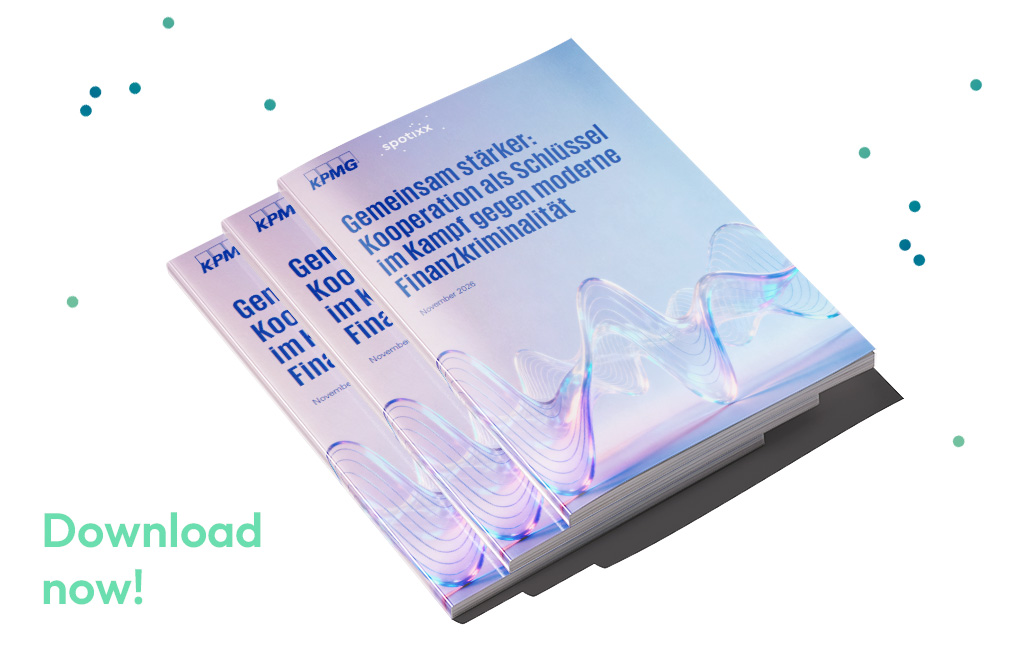
Together with KPMG Germany, we have published a whitepaper on how financial institutions can close that gap: “Gemeinsam stärker: Kooperation als Schlüssel im Kampf gegen moderne Finanzkriminalität” (Stronger together: collaboration as the key to fighting modern financial crime). The whitepaper is available in German.
What the whitepaper covers:
The regulatory shift
Article 75 AMLR creates a European framework for Partnerships for Information Sharing.
From 10 July 2027, obliged entities will be able to share specified AML-relevant information, including transaction-related information, where strictly necessary for customer due diligence and suspicious-activity reporting, subject to clear governance and data-protection safeguards.
The Payment Services Regulation adds a complementary framework for payment service providers to share fraud-relevant data where there are objectively justified grounds to suspect fraudulent behaviour. Collaboration is no longer just permitted, it is expected.
The problem today
A suspicion means a phone call or an email, then weeks of waiting. Fraudsters flagged at one bank open a new account at the next. Networks spanning several institutions remain invisible.
The solution
The spotixx information Sharing Platform built on the Roseman Labs multi-party computation (MPC), enables banks and financial institutions to collaborate quickly, securely and digitally in cases of suspected fraud. As domain expert, spotixx provides the fraud data-sharing application, bringing hands-on expertise in fraud information-sharing, fraud workflows and user interfaces. Instead of telephone and email, institutions work in a structured online environment with a dashboard, graph analysis and chat.
Fighting financial crime across institutions:
what changes in practice.
- Shared watchlists across institutions instead of internal blocklists
- Graph analysis that uncovers hidden networks across institutional boundaries
- Fraudsters detected even when they switch banks
- Real-time collaboration via dashboard and chat instead of phone and email
- Prepare complete case files for FIU reporting in one click
KPMG supports institutions through the full implementation, from strategy to technical rollout, covering the regulatory, organisational and technical requirements.
The regulation is coming, and the technology already exists. While the framework takes effect in 2027, the technology to prepare for it already exists. Institutions that start building the right governance, partnerships and technical foundations now will have a clear head start.
Download the whitepaper by clicking on the image below or by clicking on this link.
Are you responsible for AML,
fraud prevention or compliance at a bank or payment service provider?
Leave us a message and let’s talk about what Article 75 AMLR and PSR’s fraud-information-sharing provisions mean for you and your institution.